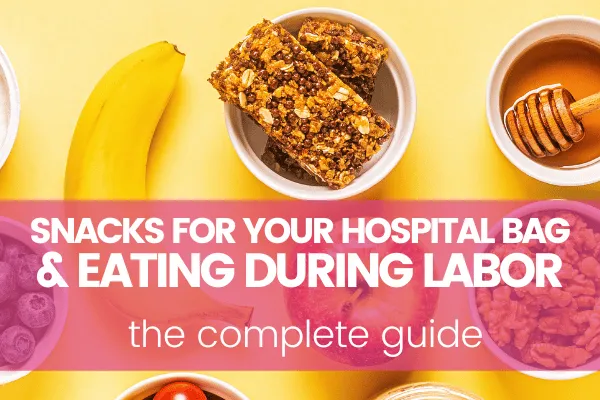
Snacks for your Hospital Bag & What to Know about Eating during Labor
This article may contain affiliate links. This means that if you make a purchase through these links, we may earn a small commission at no additional cost to you. Learn more about affiliate links.
If you're packing your hospital bag and trying to figure out what snacks to bring for labor (and whether anyone is actually going to let you eat them), you're in the right place. I worked in labor & delivery for 10 years, and "can I eat during labor?" was easily one of the questions I got asked the most. The real answer is that it depends a LOT more on your hospital and your specific situation than most people expect.
So below I'm going to walk you through what current guidance actually says about eating and drinking in labor, when food is more likely to get restricted, and what tends to work in early vs. active labor. Then comes the fun part: the 10 snacks I'd put in your hospital bag, plus some ideas for after delivery and for your partner (who will also get hungry, I promise).
In this article:
Why some hospitals still restrict food in labor
When eating during labor is more likely to be limited
Questions to ask your provider about eating during labor
What to eat and drink during active labor
10 snacks to bring to the hospital for labor
5. Applesauce or other fruit pouches
Hospital bag snacks for after delivery
Hospital snacks for dads, partners, and support people
Can you eat during labor?
Often, yes, especially in early labor. Once you're at the hospital, what you're allowed to eat depends on your birthplace's policy, your provider, and how your pregnancy and labor are going.
The American Society of Anesthesiologists (ASA) currently says people in labor should be offered clear liquids, like water, ice chips, sports drinks, pulp-free juice, and black coffee or tea. That same guidance still recommends avoiding solid food during active labor. In real life, though, policies vary quite a bit, and some hospitals and midwifery practices do allow light snacks for people with low-risk pregnancies. But the rules that actually apply to you are the ones at YOUR birthplace, which is why it's worth asking ahead of time (more on that below).
One thing I always tell people: if you're in early labor at home and you're hungry, eat. Labor can be long and really exhausting, and food is fuel. Unless your provider has specifically told you otherwise, you don't need to stop eating just because contractions started.
Why some hospitals still restrict food in labor
The strict "nothing to eat in labor" rules go back to the 1940s, when general anesthesia was used for birth much more often than it is now. When you're under general anesthesia, there's a risk of inhaling food or stomach contents into your lungs (this is called aspiration), so keeping everyone's stomach empty made a lot of sense back then.
Today, most C-sections are done with a spinal or an epidural, and you're awake for the whole thing. General anesthesia during birth is uncommon and is usually saved for true emergencies or for situations where a spinal or epidural can't be used or isn't working well. But because it can't be ruled out completely, a lot of hospitals still limit solid food once you're in active labor, just in case.
When eating during labor is more likely to be limited
Basically, the higher your chances of needing a C-section (or general anesthesia), the more likely you'll be asked not to eat. Depending on your hospital, that can include:
A high-risk pregnancy, like preeclampsia, poorly controlled diabetes, or a baby who isn't tolerating labor well
Having an epidural
A planned C-section
In these situations you'll usually be limited to clear liquids and ice chips, and sometimes they'll limit how much clear liquid you have too. This is also where hospitals differ the most. Some are totally fine with clear liquids after an epidural, and policies on eating while you're being induced (before labor really gets going) are all over the place. And for the record, the ASA says you shouldn't be denied an epidural just because you've eaten.
Questions to ask your provider about eating during labor
If being able to eat during labor matters to you, bring it up at your next prenatal appointment. Your provider can tell you what's allowed where you're delivering and whether they're comfortable with you eating in your particular situation. Here are a few questions worth asking:
What is the official policy on eating and drinking during labor at my birthplace?
What's your personal approach to eating and drinking in labor?
What do you recommend for eating and drinking while I'm laboring at home?
Is there a point in labor when what I can eat or drink would change?
Does having an epidural or being induced change what I can have?
If eating is allowed, does the hospital have snacks available, or should I bring my own?
What to eat during labor
There aren't really hard and fast rules here, but some foods definitely work better than others. And you probably won't want anything heavy, greasy, or super filling anyway. Labor tends to take care of that craving for you.
Think light foods and drinks that either give you a quick boost of energy or have some staying power. Labor can be a marathon, and it helps to have something in the tank.
What to eat in early labor
A lot of people completely lose interest in food once active labor kicks in, so early labor at home is a good time to fuel up if you're hungry. Trail mix, nut butters, light soup, smoothies, and fruit are all good options because they're fairly easy to stomach but still give you real energy. If you can handle some protein during early labor, go for it, because it'll help you keep your energy and strength up for later.
What to eat and drink during active labor
Eating usually gets harder during active labor, so this is when I'd focus on drinks with electrolytes and a little sugar, like a sports drink or coconut water. The ASA guidance specifically encourages electrolyte drinks as part of the clear liquids offered in labor.
If you can't stomach much but could use a quick boost, honey sticks, applesauce pouches, popsicles, Jell-O, and hard candy are good options. Just know that some of these count as clear liquids and some don't, so check what your hospital allows at this point. And if you have gestational diabetes (or any type of diabetes), ask your care team how they want you to handle sugary drinks and snacks during labor.
10 snacks to bring to the hospital for labor
Okay, assuming you're cleared to eat during labor, here's what I'd actually pack. Snacks in your hospital bag are a must. Even if you don't eat them during labor, your support people probably will, and I can almost guarantee you're going to be starving after your baby arrives.
1. Honey sticks
This is hands down my favorite labor snack and the one I think EVERYONE should pack. Honey sticks give you a quick hit of energy from a natural source of sugar, and they take about two seconds to eat.
During my years in L&D, even people who really didn't want to eat anything in labor could usually manage a honey stick when things were getting long or exhausting. They can be weirdly hard to find in stores (even at places like Whole Foods), so you might want to just order a pack online or check your local farmers market.
2. Nut butter packets
Almond butter, peanut butter, cashew butter... any of them make a great labor snack because you get healthy fat, calories, and protein all in one, which gives them serious staying power.
Justin's Nut Butter Squeeze Packs are really convenient for eating straight out of the packet or squeezing onto bites of banana, but a regular jar of nut butter works too.
3. Bananas
Bananas travel well, they're easy to eat, and the natural sugar can give you a boost of energy if your labor is a long one. They also pair really well with nut butter and honey sticks, so you can basically build yourself a little labor charcuterie board.
4. Granola bars
Granola bars are about as low-effort as it gets, so toss a few in your hospital bag and you're done. They have carbs and fiber to help keep your stamina up, and you can pick ones with a bit of added protein if you want more staying power.
5. Applesauce or other fruit pouches
Applesauce and other pureed fruit pouches are so good for labor. They're easy to pack, easy to eat, hydrating, and have natural sugars, and you can either sip on them slowly or suck one down for a quick boost. GoGo squeeZ makes a variety pack that I like.
6. Coconut water
I know coconut water isn't technically a snack, but it's such a good drink for labor that I had to include it. It's hydrating and has electrolytes to help replenish you while you're working hard in active labor. If you're trying to avoid added sugar, check the label, because some brands add it.
Any electrolyte drink, like Gatorade or Pedialyte, works well too.
7. Gum
Gum helps with dry mouth and can be a nice distraction during contractions. Some people also find that strong mint gum takes the edge off nausea, which is handy since nausea during labor is pretty common.
There's actually a small 2022 randomized trial published in BMC Pregnancy and Childbirth that compared chewing mint gum, using virtual reality, and routine care during the first stage of labor (93 people total). Both the gum group and the VR group had significantly lower pain and anxiety scores than the routine-care group, right after and again 30 minutes later. It's one small study, so I wouldn't call gum a pain management plan, but as a cheap, easy distraction? I'm into it.
So can you chew gum during labor? Often, yes, but it's still worth asking. Some hospitals would prefer you skip it at certain points, like if you're heading into surgery.
8. Hard candy
Hard candy works a lot like gum. It's a good distraction, it helps with dry mouth, and some people find it helps with nausea too.
9. Pretzels and/or crackers
Some people really crave something salty or crunchy during labor, and pretzels or crackers are perfect for that. Pair them with nut butter for extra staying power, and if you're feeling a little nauseous, plain saltines are a solid choice.
10. Trail mix
Like nut butter, a nut-based trail mix gives you a good mix of healthy fats, calories, and protein, and the dried fruit adds some natural sugar. If it sounds good and you can stomach it, trail mix is a great pick.
Hospital bag snacks for after delivery
Once your baby is here, there's a very good chance you'll be STARVING. The hospital will feed you, but babies don't exactly time their arrival around cafeteria hours, so it's really nice to have something on hand in the middle of the night or between meals.
Most of the snacks above work great after delivery too. This is also when you'll probably want the more filling stuff you had zero interest in during labor, like protein bars, crackers and cheese, or whatever substantial snacks your partner brought (you can steal theirs). A lot of people are also really thirsty after birth, especially while breastfeeding, so pack drinks along with the food. And if you're still working on the rest of your bag, I keep a hospital bag list on Amazon with the stuff I'd pack.
Hospital snacks for dads, partners, and support people
Your partner or other support people need food to keep their energy up during the marathon of labor too. The list I'd recommend for them is pretty much the same as yours.
They may also want some more substantial snacks, like:
Pita and hummus
Peanut butter and jelly sandwiches
Hard-boiled eggs
Protein bars
Any of their other go-to snacks
Eating before and after a planned C-section
If you have a planned C-section, you won't be eating beforehand. You'll usually be asked to stop eating solid food several hours before surgery (often around 8 hours), but you may be allowed clear liquids until about 2 hours before. Some hospitals also give you a carbohydrate drink up to about 2 hours before surgery as part of an enhanced recovery plan (usually only if you don't have diabetes).
Every hospital and provider does this a little differently, so ask for your exact instructions and follow them closely. This part really matters, because your surgery can be delayed or even canceled if you don't follow the fasting guidelines. I also get into why you can't eat before a C-section in my C-section Q&A episode.
After a C-section, nausea and vomiting are pretty common, so it's normal to start slow. Older practice was to stick with ice chips and clear liquids for several hours, but a lot of hospitals now follow enhanced recovery protocols that get you sipping water within about an hour and back to regular food within about 4 hours, as long as you're tolerating it. Light things like crackers, applesauce pouches, and broth are nice to have around for that first stretch.
The bottom line on eating during labor
Whether you can eat during labor really comes down to your hospital, your provider, and how things are going for you, so ask before the big day instead of finding out mid-contraction. And either way, pack the snacks. Worst case, you didn't eat them during labor and now you have a bag full of food at 3 a.m. with a newborn, which is honestly not a bad situation to be in.
If you're still packing, my free Hospital Bag Checklist is an easy way to make sure nothing gets left behind, and I talk through the whole bag in my podcast episode on hospital bag must-haves.
If you want more of this kind of stuff, I share education and tips on all things pregnancy, birth, and postpartum over on Instagram at @mommy.labornurse.
~Liesel